Saturday, July 7, 2012

Need a Ride along the Gulf? Water Taxi is here!


DAVAO WATER TAXI
 is another first in the Philippines! Mobility between mainland Davao City and the Island Garden City of Samal will be faster and more convenient to tourists and locals alike. 


Just like any other land-based taxis, the water taxi also has a meter. It can carry up to 14 persons including the boat captain. Fare is Php700 for four passengers for the first 5 kilometers and additional Php50 per passenger for the next succeeding kilometer. It is very safe as all units are complete with safety equipment such as life vests availability of navigation facilities in the designated areas.


The water taxis has the capacity of up to 12 passengers and can generally be booked for boat transfers. 

Private chartering and island group tours can also be arranged in advance. . It is also accredited by the Maritime Industry Authority or MARINA.


The water taxis are based at Sta. Ana Wharf in Davao City with business hours from 6:00 AM to 7:00 PM and can also be chartered for boat transfers and island group tours. 

Davao Express Water Taxis are available to and from any part of Davao Region and IGACOS. It can pick up and drop off at any public and private coastal attractions, restaurants, resorts and wharves. 

Company manager Jheannie Lava Callao, said the water taxis would sail off from Sta. Ana Wharf, Sasa Wharf, Lanang and Water Insular Hotel to any point in the Island Garden City of Samal (Igacos).
“Hopefully, we will be operational next week,” Callao said.
If the passenger load is good, we will be adding three more units, said Callao of the taxis that run on maximum speedof 22 miles per hour. The company has invested P10 million into the venture, the first of its kind in the country and considered as “pioneering investment” by the Board of Investments.

Source: Google "Water Taxi in Davao"

Elegant and Sophisticated Black Taxi in Davao


The Mabuhay Group recently launched its fleet of black taxicabs. More than just a new cab color, the black taxi will debut topnotch technology for public transport in Davao City.Black-Taxi-600x450


The transport innovation was the idea of Pierre Ryan Tan, assistant manager of Mabuhay Taxi, who thought of addressing the passengers' common complaints against taxi drivers who do not give exact change. 
The taxis will accept payments from Bancnet and Megalink ATM and debit cards. 


The cabs are also safer for passengers because they have a Global Positioning System tracking device that will automatically give information on the current location of the vehicles, according to Tan.

"It also has an emergency button. It has a security feature that will automatically inform us of the driver's location, engine on, engine off," added Tan.


Leoloy Nahi-al said that the innovation would not only benefit the riding public but the drivers of the black taxis like him, as well. 

"I think our income will also increase...commuters won't have second thoughts riding a taxi because they can use their ATM in case they don't have cash," Nahi-al said in Filipino. - with Aliana Gimena
 Source: Google " Black taxi"

Thursday, July 5, 2012

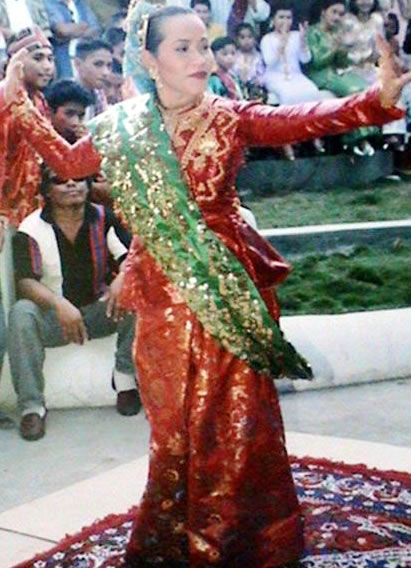
People of the Current (Tausug) tribe in the Philippines


File:Tausug.jpg


The Tausūg or Suluk people are an ethnic group of the Philippines and Malaysia. The term Tausūg was derived from two words tao and sūg (orsuluk) meaning "people of the current", referring to their homelands in the Sulu ArchipelagoSūg and suluk both mean the same thing, with the former being the phonetic evolution in Sulu of the latter (the L being dropped and thus the two short U's merging into one long U). 


File:PhetandingKoBayanan.jpg


The Tausūg people in Sabah refer to themselves as Tausūg but refers to their race as Suluk as documented in official documents such as birth certificates in Sabah,Malaysia. The Tausūg are part of the wider political identity of Muslims of Mindanao, Sulu and Palawan known as the Moro ethnic group, who constitute the third largest ethnic group of MindanaoSulu and Palawan.


They originally had an independent state known as the Sulu Sultanate, which once exercised sovereignty over the present day provinces of BasilanPalawanSuluTawi-Tawi, and the eastern part of the Malaysian state of Sabah (formerly North        Borneo).
Tausūgs are experienced sailors and are known for their colorful boats or vintas. They are also superb warriors and craftsmen. They are known for the Pangalay dance (also known as Daling-Daling in Sabah), in which female dancers wear artificial elongated fingernails made from brass or silver known as janggay, and perform motions based on the Vidhyadhari (Bahasa Sūg: Bidadali) of pre-Islamic Buddhist legend.
Prior to modern times, the Tausūg people were under the Sultanate of Sulu. The system is a patrilineal system, consisting of the title of Sultan as the sole sovereign of the Sultanate (in Tausūg language: Lupah Sug, literally: "Land of the Current"), followed by various Maharajah and Rajah-titled subdivisional princes. Further down the line are the numerous Panglima or local chiefs, similar in function to the Philippine political post of the Baranggay Kapitan in the Baranggay system.
Of significance are the Sarip (Shariff) and their wives, Sharifah, who are descendents of Arabic royalty. They are respected as religious leaders, though some may take up administrative posts.


Source: Google "Tausug"

Tuesday, July 3, 2012

B'laan Tribe in the Philippines


The Blaan are one of the indigenous peoples of Southern Mindanao in The Philippines. Their name could have derived from "bla" meaning "opponent" and the suffix "an" meaning "people". Other terms used to refer to this group are Blaan, Bira-an, Baraan, Vilanes, and Bilanes.


The Blaan, are neighbors of the T'boli, and live in Lake Sebu and T'boli municipalities of South CotabatoSaranganiGeneral Santos City, the southeastern part of Davao and around Buluan Lake in North Cotabato. They are famous for their brassworks, beadwork and t'nalak weave. The people of these tribes wear colorful embroidered native costumes and beadwork accessories. The women of these tribes, particularly, wear heavy brass belts with brass 'tassels' ending in tiny brass bells that herald their approach even when they are a long way off.
Some Blaan natives were displaced when General Santos City was founded in 1939. Others settled in the city.
Their language is said to be the source of the name for Koronadal City, from two Blaan words – koron or kolon meaning cogon grass andnadal or datal meaning plain, which aptly described the place to the natives. On the other hand, Marbel, which is another name for the poblacion, is a Blaan term Malb-el which means "murky waters" referring to a river, now called Marbel River.
The tribe practices indigenous rituals while adapting to the way of life of modern Filipinos.

Tuesday, June 26, 2012

The Island that vanish


Vanishing island refers to any permanent island which is exposed at low tide but is submersed at high tideVanishing islands occur globally.   There are seven vanishing islands in the Philippines and several in the San Juan Islands.


One of it is in 
Barangay Tambo, Island Garden City of Samal.  The place was beautiful and amazing because the Vanising Island is situated in the middle of the sea. 


When it is low tide, the sand bar will come out and you can enjoy walking, meet the starfishes, hermit crabs, sea worms which looks like snakes, sea urchin,  
sea shells and many more. 


There is an area which is  Government owned and the other areas are privately owned.  It includes white sand as one of its tourist attraction and the water was clear and you can enjoy snorkeling, swimming, diving and some other types of underwater adventure. 


There are also mangroves are planted here.
You can also stay overnight in some cottages owned privately but you should be prepared. Since there is no source of power light, rechargeable emergency light is useful. When at night the place was very cold and you may need a tent. In the afternoon the island starts to vanished, the sand is slowly covered with sea water and you can enjoy swimming near in your cottage. If you are looking for a place to relax, this is one of the best place to stay.

When Nature Strike


Heavy rain poured all through the night of June 28, 2011 that causes a flash flood in some areas of Davao City. I was having a training as a phlebotomist in one of the hospital here in our City. As my way home that night slow yet continuous rain poured, heavy traffic with different car accidents in various places that I passed and the water in the bridge is starting to over flow. 


We thought it was just ordinary situation we experience when heavy rain poured like before.

It was almost 2am in the morning when I woke up and heard my mother in her loudest voice. She was talking to my auntie living near in the river where the water over flows the bridge that I recently cross. Flash flood my mother told us. Few houses was swept away by the strong current of water coming from the mountains. 


The only communication we had to know the things have been happening in our city was the radio. Every now and then my mother checked the situation where my auntie located
She was separated from her four children, because they (her husband) are trying to save their things and the pigs my mother asked them to take cared of.


It was almost 5 am, I saw the sun rising and I was preparing to go on duty. Few jeepneys are running, I thought maybe because of the rain last night. But when we reach the area where the flash flood happened I was shocked. Jeepneys and cars are moving slowly. The traffic I experience was about 2-3 hours.That's the time I saw cars are inside the garage of another house, some are parked upside down,some bumped to each other .Wreck gates and houses houses are cover with mud,  some . 


I was devastated looking into the families watching there wreck properties.  It was a nightmare not just to them but to all of us dabaweños. A tragedy that killed many people most of them are children.


Sunday, June 24, 2012

A Place to Watch - Bantayan Island


Santa Fe is a 4th class municipality in the province of Cebu, Philippines. According to the 2010 census, it has a population of 27,270 people. The municipality's territory includes the eastern portion of Bantayan Island (bordering on the town of Bantayan), as well as Guintacan (or Kinatarcan) and Hilantagaan Islands.

Bantayan Airport, serving Bantayan Island, is located in Santa Fe. The town can also be reached by ferry from Hagnaya Wharf in San Remigio, Cebu.


Santa Fe is one of the most crowded municipalities during Holy Week; it caters to a number of tourist and locals that spends their holiday in the island of bantayan.


Early History of Bantayan Island

The first full time residents of Bantayan Island, arrived on the island during the period of time from 1635-1645. The king of Spain used the island as an advanced warning system for the larger islands of Cebu, the Visayas and Luzon. Muslim marauders called “Moros” frequently made their way up from Mindanao invading the Christian settlements in the Visayas, murdering and robbing the people inhabiting these areas.

Because Bantayan Island is a natural barrier for entrance into the Visayas, small watchtowers were constructed all over Bantayan Island to serve as lookout post for invading Moros.The name “Bantayan” comes from the Cebuano term that means “A Place to Watch”. The places of lookout were called in Cebuano: “Bantayan sa Hari”, meaning “A place to watch for the king”. The people who lived on the island adopted the term that described the purpose of their being there and shortened the name to “Bantayan Island”


Super Shuttle ferry going to Bantayan Island.
Rid
ing in this shuttle going to Bantayan takes you an hour of travel with a 170 pesos fare rate. When you get to the port of Bantayan Island Sta. Fe, transportation is not a problem. There are many jeepneys, tricycle and motorcycles waiting for the visitors.


Resorts are not a problem also, too many beach resorts are available and you can ask the locals for the best though expensive or the cheapest resorts yet far from the port.


The beach have a white fine sand. It is like a powder when you grasp it with your palm.


The water was warm and crystal clear. You could actually see your feet on the water and there are no stones or corals when you swim.


But before going in Bantayan Island make sure to have reservations on the resort you wanted to stay because the place is one of the tourist spots in Cebu City. One of the crowded island especially in peak season.